
Maulana Azad was not only a freedom fighter but also a visionary nation-builder : Dr Khwaja Iftikhar Ahmad at the ICCR
On Maulana Abul Kalam Azad’s 68th Death Anniversary

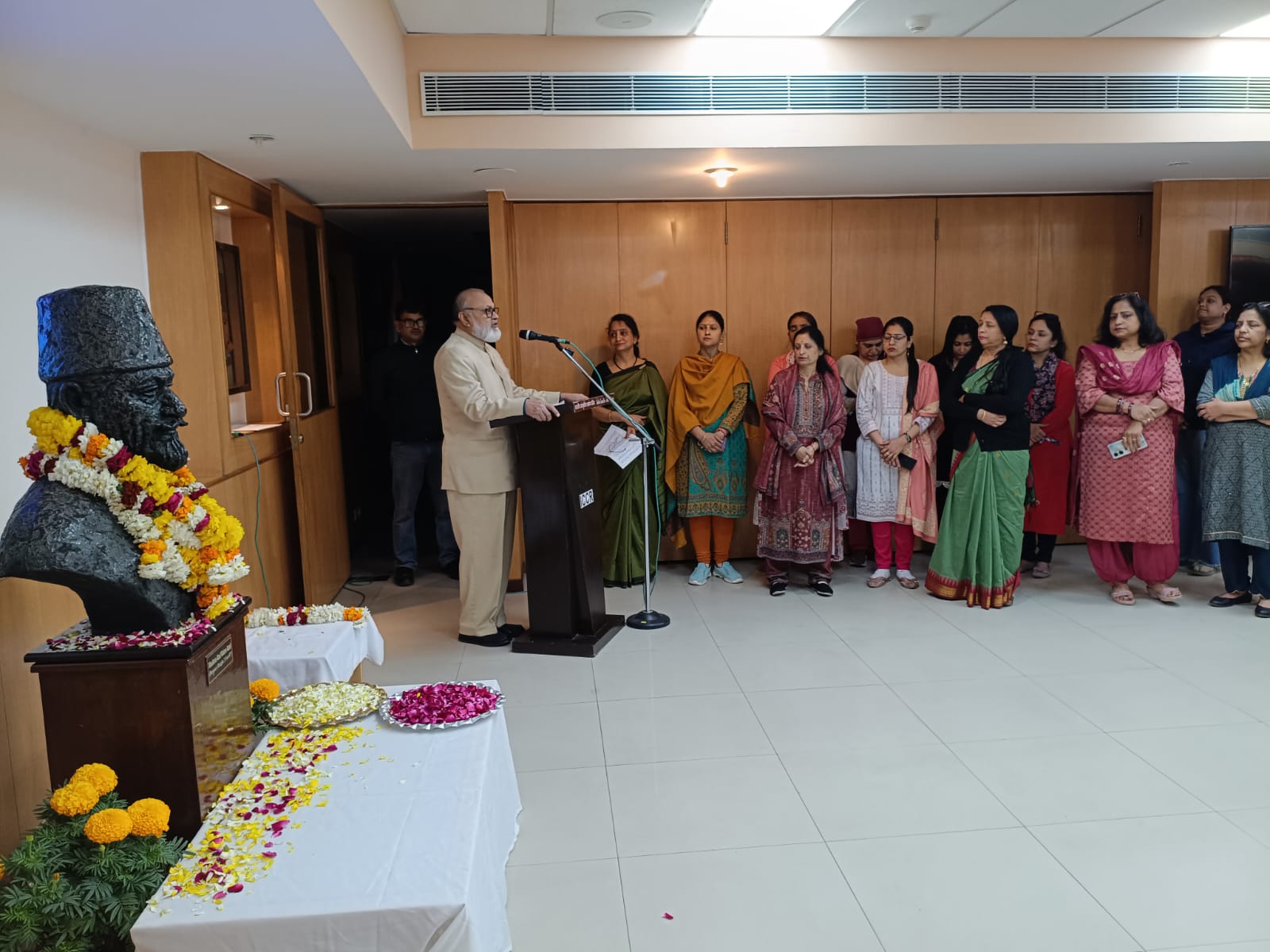
New Delhi Feb 23, 2026 : Maulana Azad was not only a freedom fighter but also a visionary nation-builder. His greatest legacy remains the educational framework of modern India and his unwavering commitment to national unity and secularism.
Dr Khwaja Iftikhar Ahmed said, Maulana Abul Kalam Azad was one of the foremost leaders of India’s freedom struggle, a renowned Islamic scholar, journalist, and independent India’s first Education Minister. His contributions span politics, education, journalism, and national integration. His birth anniversary is observed on November 11, as the National Education Day.
Azad became the youngest President of the Indian National Congress in 1923). He was again elected as Congress President from 1940 to 46 during the crucial phase of the freedom struggle.
He was the strong supporter of the “Non-Cooperation Movement” and “Quit India Movement” led by Mahatma Gandhi.
Maulana opposed the partition of India tooth and nail and consistently advocated Hindu–Muslim unity. Maulana Azad was Imprisoned several times by the British for his nationalist activities. Beyond an iota of doubt, he was the architect of modern Indian education
As Independent India’s first Education Minister from 1947 to 1958, Azad laid the foundation of India’s modern education system by establishing the UGC (University Grants Commission). He played a key role in founding –
the IITs (Indian Institutes of Technology). He strengthened the roots of cultural nationalism by establishing the
Sahitya Akademi and Lalit Kala Akademi. For the promotion of Urdu, he founded Taraqqi-e-Anjuman-e-Urdu.
By promoting free and compulsory primary education for all children, he put India on the fast track of progress in all walks of life.
Maulana Azad emphasized scientific and technical education to build modern India. In his days, he was the unquestioned emperor of journalism and intellectual contribution.
One of the biggest journalistic achievements of Azad was the publication of the revolutionary Urdu weekly, “Al-Hilal” in 1912, which inspired nationalist sentiments among Muslims. When the English saw that the newspaper was uniting Hindus, Muslims and Sikhs, they forcibly closed it down. Later, Maulana began, “Al-Balagh” that too was confiscated by the English in 1916.
He authored the famous book, “India Wins Freedom”, a key historical account of India’s independence, of whose last 30 pages, as per his desire, were to be published 30 years after his death, as he the best friend of Jawahar Lal Nehru but was peeved against both Gandhi and Nehru, as against his wishes, he agreed for the vivisection. The gap of 30 years was kept so that by that time, none of these two stalwarts would be alive. These 30 pages were published in 1988 by the publishers, the Orient and Longmans, but not the original ones, as these were changed as the truth would have created a flutter against the Congress, according to Azad’s nephew, Nooruddin Ahmed
Azad was the champion of communal harmony and advocated “Muttahida Qaumiyat” (communal concord). He believed that India’s strength lies in its cultural and religious diversity. He vehemently rejected the two-nation theory. For his never say die contribution to the country, he was awarded the Bharat Ratna posthumously in 1992.
