
When Maulana Azad asked his nephew to resign from the ICCR job
(Firoz Bakht Ahmed's treatise at the ICCR on the occasion of Maulana Azad's 68th death anniversary)
By FIROZ BAKHT AHMED

Mahatma Gandhi, Maulana Azad, Pandit Nehru, Sardar Patel, Rajender Babu, Lal Bahadur Shastri — They were men of principles, whose idealism helped bring freedom to the country. But in the process, did their idealism also affect their families? Most of these leaders, in fact, genuinely believed they would be doing the country a great disservice if they promoted their kith and kin.
Probably the leaders of the freedom struggle, having experienced the hardships and turbulent days, knew that their responsibility then lay in nation building. At all costs, they made sure their family members did not take undue advantage of their position, always emphasizing on giving to the country rather than taking.
For instance, take the much-talked about rift between Maulana Azad and his nephew Nooruddin Ahmed (who was his elder brother Abu-n-Nasr Aah Ghulam Yasin’s only son and author’s father). Many believe it arose because Azad did not recommend his nephew’s name for a job at the ICCR (Indian Council of Cultural Relations), as he didn’t want to be accused of nepotism.
Maulana Azad simply abhorred the fact that his relatives should come to him for favours. My father, though a graduate from Calcutta’s St. Xavier’s College and a man of letters, didn’t do any work.
Once it so happened that at the ICCR, the post of the librarian got vacant and Maulana Azad was not in Delhi, his nephew got the job at a monthly salary of Rs. 325 per month at the behest of the secretary SMH Burney.
When Maulana Azad came to know about this, he asked his nephew to resign on September 05, 1956 writing in his note filing that the post of the librarian be given to someone else.
Likewise Baquar Hussain, a very distant nephew of Maulana Azad, and distributor of feature films, wanted the allotment of a Bombay distribution company in his name.
Maulana plainly refused saying that in his eyes, it was unethical to please one’s relatives and strictly dissuaded one and all. Yet some people trying to claim Azad’s legacy are cashing in his name by morphing their pictures and other means.
Frankly speaking, Maulana Azad’s family life both in Calcutta and Delhi was almost negligible and next to nothing when it came to expenses as he was a man made for Indian freedom struggle and most of his time got consumed in political meetings with Mahatama Gandhi, Pandit Nehru, Sardar Patel, Maulana Mohammed Ali and Shaukat Ali, Aruna Asif Ali and umpteen others.
Besides, He had no issue except one child Hussain who didn’t survive long. Maulana’s lifeline and wife Zulekha was a very caring, loving and educated Calcutta based woman whose elder sister Hafiza was the wife of his elder brother Maulana Ghulam Yasin Abu-n-Nasr Aah who was also a poet with pen name “Abu-n-Nasr Aah”. “Aah” died at the young age of about 24 in 1906 and his only son Nooruddin Ahmed Sahab (my father) who was born posthumously, was taken care of by Azad.
Therefore, Nooruddin Sahab was like Maulana’s son. My mother used to frequent the house of Maulana in Delhi at 4 King Edward Road (now the official part of Vigyan Bhawan, as it was razed to make way for it) and was fond of the pomegranates on trees in the compound. At home in Delhi Maulana Azad used to be mostly buried in his books in his study.
While Maulana Azad was imprisoned in Ahmednagar Fort in the aftermath of Quit India resolution, he received a telegram that his beloved life-partner Zulekha passed away on April 9, 1943. Maulana recounted in his letter to Maulana Abdul Razzaq Malihabadi, editor of Azad Hind Urdu daily that he had wept when he visited her grave.
Incidentally, he lost his elder sisters Hanifa Begum ‘Aabru’ and Khadija Begum in 1943 only. It is another of those coincidences that during his incarceration at the same time, the Mahatama lost his life-companion, Kasturba — thus putting a stamp of woman sacrifice on the freedom struggle. The third sister was Fatima Begum ‘Aarzu’, who died on April 13, 1966.
My father, who had been living with Maulana Azad right from the time of his birth being born posthumously to Maulana Ghulam Yasin Abu-n-Nasr Aah, was a great fan of his and considered him as his ideal. Despite being born in a predominantly Hindu environment, Azad was bold enough to propagate nationalism to Muslims at variance with the prevalent political consciousness based on communalised politics. Maulana coalesced with endogenic creativity, the Vedantic vision of many parts of truth with the Islamic doctrines of “Wahdat-e-Deen” (unity of religion) and Sulah-e-Kul (universal peace).
It is clear according to him that Maulana Azad was not only this century’s most articulate votary of Hindu-Muslim unity but also the only one who claimed Quranic sanction for his faith in that unity.
My father was very impressed by the fact that Maulana had an unshakable faith in India’s heritage as providing a natural environment for national integration in the principle that he called Ummat-e-Wahida. Like Khan Abdul Ghaffar Khan, Maulana Saheb struggled against divisive, parochial and myopic politics.
An interesting anecdote that my father told me proving Maulana Azad to be an excellent orator goes like this. While he was donning a torn and patched shervani (long over coat), Maulana Azad’s private secretary Ajmal Khan pointed that he was to deliver a speech before the prime minister and others on the occasion of the inauguration of the Sahitya Akademi on March 12, 1954 and that he should dress accordingly.
Maulana Sahab shot back with a crisp reply in his sonorous voice, “Ajmal Sahab, no one will look at my shervani but everyone will listen to what I say!” At that time, as per the laundry records of Maulana Azad, he possessed only six shervanis (two of them had patches on them!). He owned a very limited wardrobe primarily because he could not afford to get more.
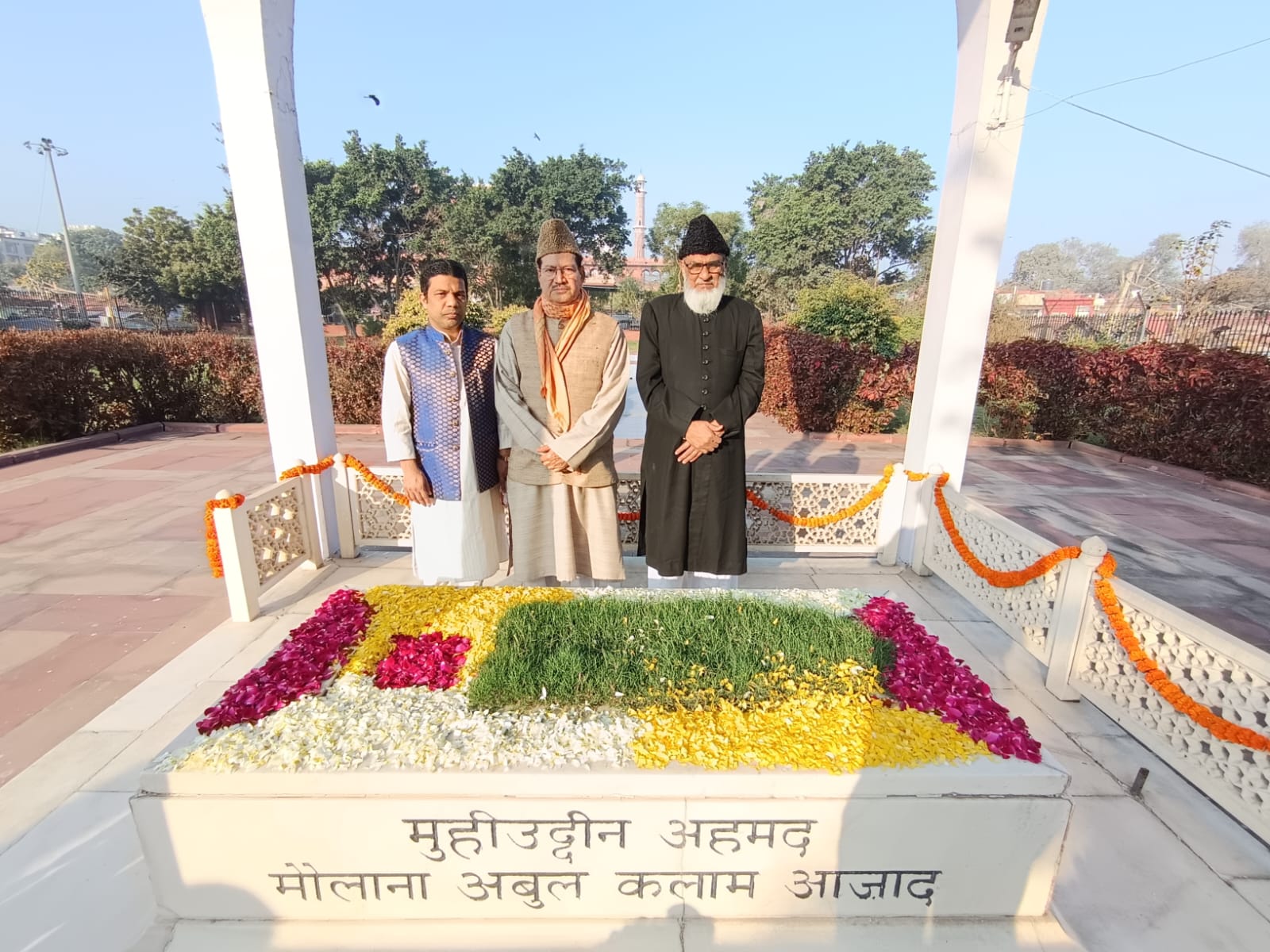
Maulana Abul Kalam Azad’s mausoleum before the Jama Masjid in Delhi, on the other hand, is not no greatly frequented. The relative neglect of his tomb suggests that many Indian Muslims may have lost interest in keeping his memory alive. He was no lesser than Gandhi and Nehru, whose designer and state of the art samadhis (last resting places) are visited by the dignitaries but the Azad tomb lies deserted and was the abode of anit-social elements and dogs till it was secured and preserved in 2005 through a PIL at Delhi High Court by the author.
In his landmark, historic and stunning judgment, the then Justice, Vijender Jain stated, “The contribution of Maulana Azad towards the Indian freedom struggle was bigger than that of Gandhi and Nehru!” Nobody knows this. It also suggests that Indian society as a whole may no longer value, as before, and perhaps may not even know the principles for which he stood.
(The author is the former Chancellor, MANUU, Hyderabad, grandnephew of Maulana Azad and a commentator on social and educational issues)
