
Protecting Delhi University’s Reputation in an Age of Unverified Headlines
- Prof (Dr) Jasim Mohammad
Before We Judge Delhi University, Remember the AMU Case and Its Lessons

In 2008, the Times of India published a dramatic story about Aligarh Muslim University (AMU), portraying the campus as a place where discipline had collapsed and even degrees were being “sold like toffees.” For years this report shaped public opinion, even though the article was based on anonymous claims, sweeping judgments, and no solid proof. Much later, in 2021, The Wire reported that Times of India had apologised in a Delhi court, accepting that the story had unfairly harmed AMU’s reputation. That entire journey—from sensational story to quiet apology—teaches us a powerful lesson: headlines can influence minds immediately, but correcting the damage takes years.
This old case reminds us that one strong story can easily become a permanent belief in society. A single unverified claim can grow into a widely accepted truth, simply because it appears in a well-known media outlet. People repeat it in homes, tea stalls, and online discussions. Over time, nobody remembers whether the claim was ever investigated or whether there was any real proof. This is how institutions that serve the nation for decades get hurt by shadows, not facts.

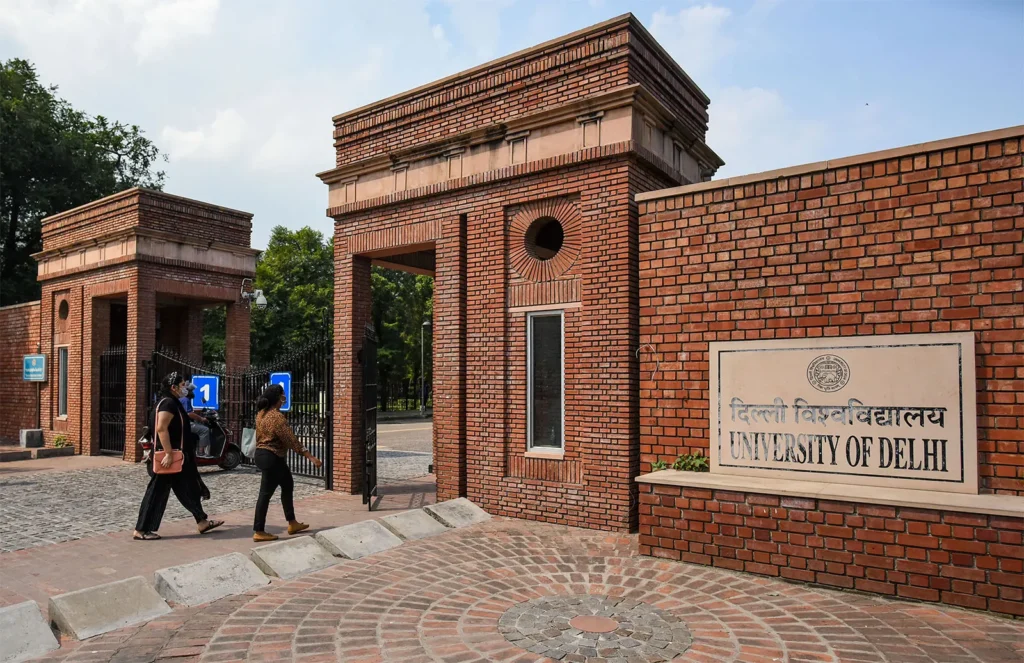
File Photo : PM attends the Valedictory Ceremony of Centenary Celebrations of University of Delhi, in New Delhi on June 30, 2023.
The recent “Rs 50 lakh for a teaching post” story about Delhi University feels very similar. It describes fear, anxiety, and mysterious demands for money, but the entire piece is built on comments from anonymous individuals. These voices speak with emotion, but they do not offer names, dates, documents, or official complaints. When an article is built on feelings rather than facts, it becomes difficult to separate genuine concerns from exaggeration.

It is important to say with clarity and honesty: if any person was truly asked for money during recruitment, that is serious. That individual must be supported, and a fair investigation should be conducted. No educator should ever be forced to remain silent. But one private experience—without any evidence—cannot be used to show that thousands of people across an entire university system are corrupt. Institutions cannot be judged on rumours.
Delhi University is not a small or ordinary college. It is an Institution of Eminence, one of India’s highest academic platforms. For decades, it has produced IAS officers, scientists, professors, journalists, activists, sports achievers, and national leaders. It is deeply unfair to treat the whole university as suspicious because of one unverified allegation. This harms the dignity of teachers who work honestly every day and give their life to education.

PM at the Valedictory ceremony of Centenary Celebrations of University of Delhi, in New Delhi on June 30, 2023.
The AMU episode from the Times of India shows what happens when institutions are judged without proper evidence. The damage becomes long-lasting. Young students stop applying. Parents worry unnecessarily. Society begins to believe that the entire system is broken. Only years later does the truth return, but by then the harm is already done. DU should not be pushed into the same painful cycle.
Even in the DU story, the report admits two important things: there is “nothing in writing,” and all the allegations exist only in whispers. When both complainants and journalists themselves agree that there is no proof or formal complaint, it becomes clear that such a story should be handled with caution, not turned into a headline that harms an entire institution.
Every large system, including universities, has delays, procedural challenges, and disagreements. This is true for hospitals, courts, public departments, and schools. These administrative issues do not automatically prove corruption. When media mixes ordinary problems with dramatic rumours, the line between fact and fear becomes extremely thin.
DU teachers are among the most qualified intellectuals in the country, many holding PhDs, years of research work, national awards, and published books. They choose teaching not for money but for love of knowledge. It is deeply hurtful to suggest that all of them operate inside a corrupt environment simply because someone, somewhere, heard a rumour.
What the report also forgets is that public universities in India operate under immense pressure. They handle huge student numbers, manage limited resources, and still produce some of the best academic results in the country. Teachers face stress, workload, and constant expectations. They deserve support and understanding, not headlines that question their integrity without evidence.
Students can also be damaged by such reports. When they read that “posts are sold,” they might begin doubting their own teachers, their exam papers, or even the value of their degrees. This emotional harm cannot be measured in money. It affects confidence, motivation, and belief in education. It is irresponsible to cause such fear without verified facts.
Reputational damage happens slowly. It is not loud. It happens through repeated stories, half-truths, and one-sided narratives. AMU experienced this for years. DU could face the same if the media does not act responsibly. Journalism must be careful because trust is delicate. Once broken, it takes years to rebuild.
If any wrongdoing exists, the correct path is simple: file a complaint, name the people involved, and allow the authorities to investigate. DU has internal committees, grievance mechanisms, and legal channels. They should be used instead of becoming silent sources for dramatic articles. If we want transparency, we must follow proper channels.
DU as an institution is far bigger than one incident or one recruitment cycle. It represents generations of scholars, libraries full of research, and decades of academic contributions. Doubting such a large and respected system on the basis of unverified voices is not only unfair—it weakens the confidence society places in education itself.
However, when Prime Minister Narendra Modi addressed Delhi University during its centenary celebrations, he spoke with a vision — calling DU “not just a university, but a movement.” He recalled how DU began with only three colleges, and now has more than 90, showing how deeply education has rooted itself in Indian society. Prime minister Narendra Modi also linked education to national progress. He said that when an institution like DU is deeply committed to the country, its successes become the nation’s success . He urged the university to hold on to its values — even as it changes: to preserve the familiar campus life, from tea at “Patel Chest” to momos at Chanakyapuri — as symbols of continuity. He also highlighted how futuristic policies are transforming education: since 2014, the number of Indian universities in the global QS Rankings has jumped from 12 to 45. He encouraged DU to prepare a roadmap: by its 125th year — when India will celebrate 100 years of independence — the university should aim to be among the world’s top institutions.
So, there is a clear difference between journalism and storytelling. Journalism requires facts. Storytelling requires emotion. When journalism starts depending only on emotion, the truth becomes vulnerable. Stories can be compelling, but institutions cannot be judged by compelling stories alone.
At a time when Indian higher education needs encouragement and reform, such negative articles create worry rather than solutions. Instead of pushing institutions forward, they pull them backward into suspicion. Articles should offer balanced analysis, not amplify fear.
The AMU example stands as a warning. It shows how easily a respected institution can be discredited, and how long it takes for justice and truth to correct the narrative. Media must learn from that history instead of repeating it with new universities.
Public universities are national assets. They belong not just to faculty but to the entire country. They need constructive criticism, professional journalism, and careful reporting—not sweeping claims built on nameless voices.
In the end, if someone faced wrongdoing, they must take courage and report it formally. Let the system investigate. Let the truth come out. But until that happens, the entire Delhi University administration, faculty, and students should not be judged or defamed. Rumours should not shape national opinion. Institutions built by generations deserve more respect than that.

(Author is Professor in Comparative Literature and Former Media Advisor of Aligarh Muslim University (AMU) Email: profjasimmd@gmail.com)
