
The Indian Diaspora: A Case of Déjà Vu
Demanding Tolerance Abroad, Embracing Polarisation at Home: The Indian Diaspora’s Dilemma

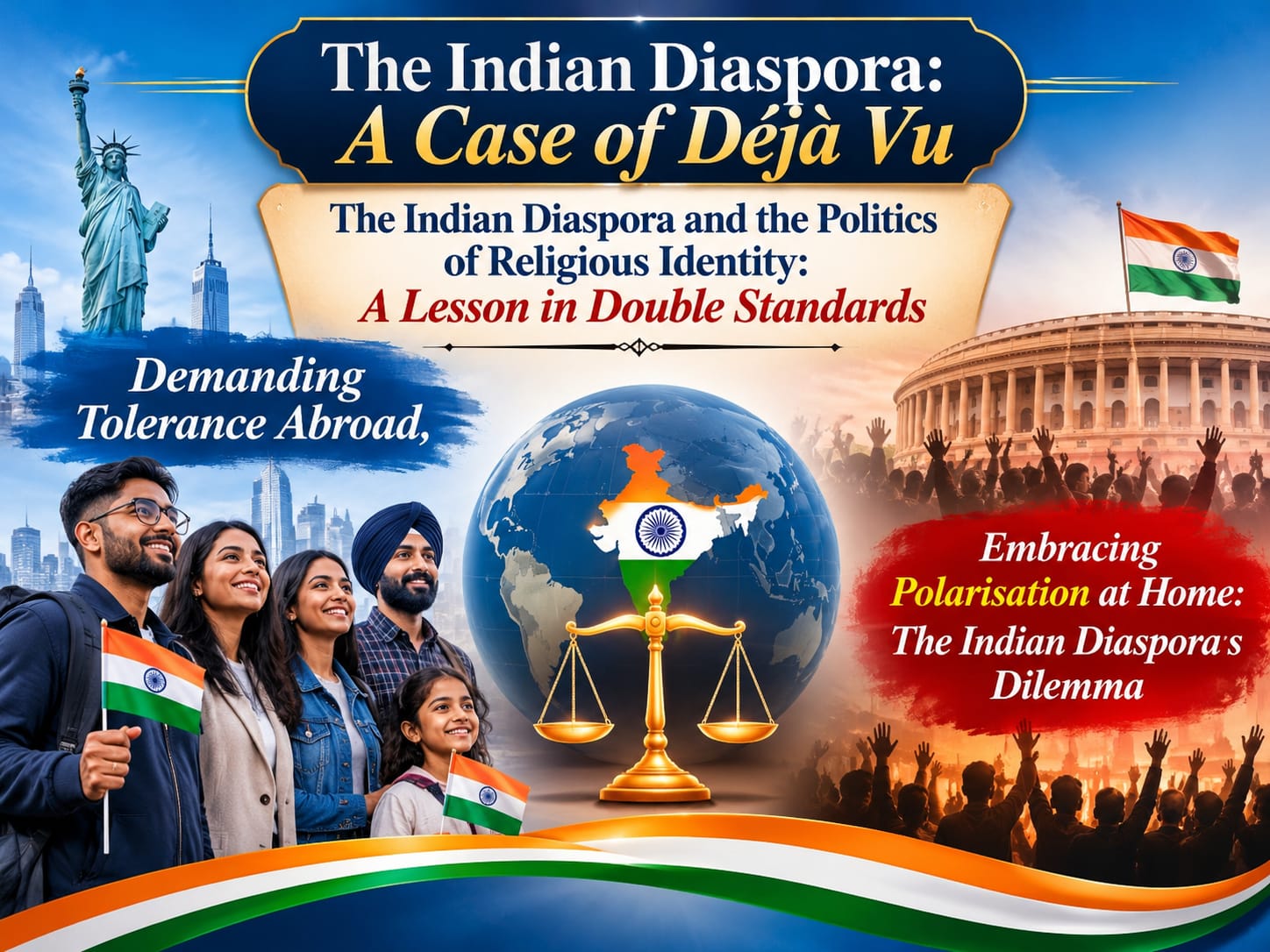
The irony of importing the politics of religious identity into societies that once welcomed us for our ability to integrate. The news emerging from Australia of anti Indian protests, the questioning and disruption of Diwali celebrations, and the growing hostility towards Indian immigrants is deeply disturbing. Much of this hostility appears to be fuelled by an increasingly assertive anti immigration politics, championed by sections of the Australian right wing.
For many NRIs, this must be an uncomfortable awakening. Perhaps they never imagined that the societies in which they had built successful lives would one day begin questioning their cultural identity, their loyalties and even their right to celebrate their festivals publicly.
There is an irony here that deserves some introspection. For decades, Indians, particularly Hindus, generally went about their lives abroad without making their religious identity the centrepiece of their public existence. They worked hard, integrated into their adopted societies, participated in the festivals of others and celebrated their own traditions without necessarily turning them into public assertions of religious identity. They were widely regarded as an industrious, successful and relatively well integrated immigrant community.
Sections of Muslim immigrant communities in the West, meanwhile, chose to preserve a more visibly distinct religious and cultural identity. Some maintained separate social practices, dietary preferences and patterns of community life, while expecting the liberal societies they had settled in to accommodate their traditions. This was not representative of all Muslims, many of whom integrated perfectly well. Nevertheless, the visible cultural separation of some sections became a subject of political debate and, eventually, a target for the far right.
But India itself began changing over the last decade. Hindu identity was increasingly thrust into the centre of political and public life. Hindus were encouraged not merely to practise their faith but to assert it, display it, take pride in it and showcase it with ever greater public visibility. Religious festivals increasingly became occasions for demonstrating collective identity and political strength.
A large section of the successful Indian diaspora enthusiastically embraced and supported this political transformation back home. Many backed a Hindu right wing movement whose politics increasingly questioned the patriotism and loyalty of India’s Muslim, Christian and Sikh minorities.
Perhaps they genuinely believed that they were different. They were Hindus, not Muslims, and therefore would not encounter the suspicion and hostility that sections of Muslim communities had experienced in the West. They may have assumed that the privileges of being a successful, educated and economically influential immigrant community would somehow insulate them from the politics of identity.
But they overlooked a fundamental truth: the politics of religious assertion does not remain confined to one religion. Once a community begins defining itself primarily through its religious identity, others may begin to see it not as an integrated part of society but as a distinct group asserting its separateness.
In their enthusiasm to assert a Hindu identity, some sections of the Indian diaspora may have unwittingly repeated the very mistake they had criticised in sections of the Muslim community.
There is another irony worth examining. There are approximately 49 Muslim-majority countries in the world, of which 23 declare Islam to be their state religion. Yet they have never constituted a politically united community. They have fought wars against one another, have territorial disputes, compete for regional influence and frequently find themselves on opposing sides of international conflicts.
The much-invoked idea of a universal Muslim Ummah, a brotherhood transcending national boundaries, has never translated into political unity. National interests, ambitions, rivalries and internal differences have invariably taken precedence.
Hindus, by contrast, have one country in which they constitute the majority. Yet Hindu society has historically been deeply divided by caste, region, language, sect and tradition. The idea of a monolithic Hindu identity, much like the imagined political unity of the Muslim Ummah, has increasingly been cultivated for domestic political purposes. In both cases, a complex and diverse community is presented as a single political entity, often obscuring its internal differences.
The tragedy is that those who disliked the perceived rigidity and separatism of one religious identity movement appear to have embraced another version of it, without recognising that the underlying mistake is essentially the same.
Today, from the United States and Europe to Britain and Australia, sections of the political right are increasingly questioning the loyalties of immigrant communities. They accuse them of bringing their culture and customs into their adopted countries, resisting integration and, at times, placing their country of origin above the country in which they have chosen to live.
For years, Indians living abroad flocked to cricket stadiums whenever the Indian team played in their adopted countries. They waved the Indian tricolour, cheered vociferously for India and celebrated its victories, even when India was playing against the country in which they lived.
What was once largely regarded as an expression of affection for one’s homeland and cultural roots is now, in some political quarters, being portrayed as evidence of divided loyalties.
There is, of course, nothing inherently wrong with loving the country of one’s birth, celebrating its festivals, supporting its cricket team or preserving one’s cultural traditions. Nor should these expressions automatically be construed as disloyalty to one’s adopted country. But immigrants must also understand that integration, mutual respect and a genuine sense of belonging are essential to the societies they have chosen to make their homes.
One cannot demand tolerance for one’s own cultural and religious assertions while being indifferent to the sensitivities of others. Nor can one champion a majoritarian religious identity at home and expect the same politics of identity to be entirely absent from the countries in which one lives.
The world is passing through an extraordinary period of turmoil. Nations are increasingly confronting one another, but societies within nations are also turning against themselves. We may not have witnessed a third world war, but the extent of polarisation, fragmentation and hostility within and between countries is deeply alarming. The fault lines of religion, race, ethnicity, nationality and culture are widening. The social fabric of the world seems more fractured than it has been for generations.
Reversing this trend will require a collective effort. But perhaps the starting point is not so complicated.
We must learn to respect other people’s cultures and religions without feeling threatened by them. We must abandon the notion that our faith, our traditions or our way of life are inherently superior to those of others. We must recognise that integration does not require the abandonment of one’s identity, just as preserving one’s identity does not confer the right to impose it on others.
Religious pride need not become religious assertion. Cultural identity need not become cultural isolation. And patriotism need not become a test of religious conformity.
Perhaps the greatest lesson for India and its diaspora is that the freedom to practise one’s faith, the freedom to preserve one’s cultural identity and the freedom to belong to a larger, diverse society are not competing ideas. They are the very foundations of a liberal democracy.
We cannot demand acceptance abroad while denying equal acceptance to minorities at home. We cannot preach integration in our adopted countries while celebrating religious polarisation on our own.
The world does not need communities competing to establish the superiority of their religious identities. It needs citizens secure enough in their own identities to respect those of others. That, ultimately, is the difference between merely living in a country and truly belonging to it.
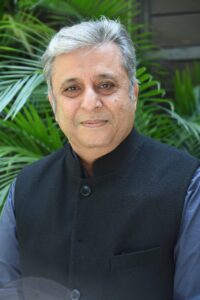
(Saeed Shervani is a political anaylist . thinker , a hotelier by profession involved in many citizens initiatives . He was the President of the Federation of Hotel and Restaurant Association of India . Email : shervanioffice@gmail.com)
