

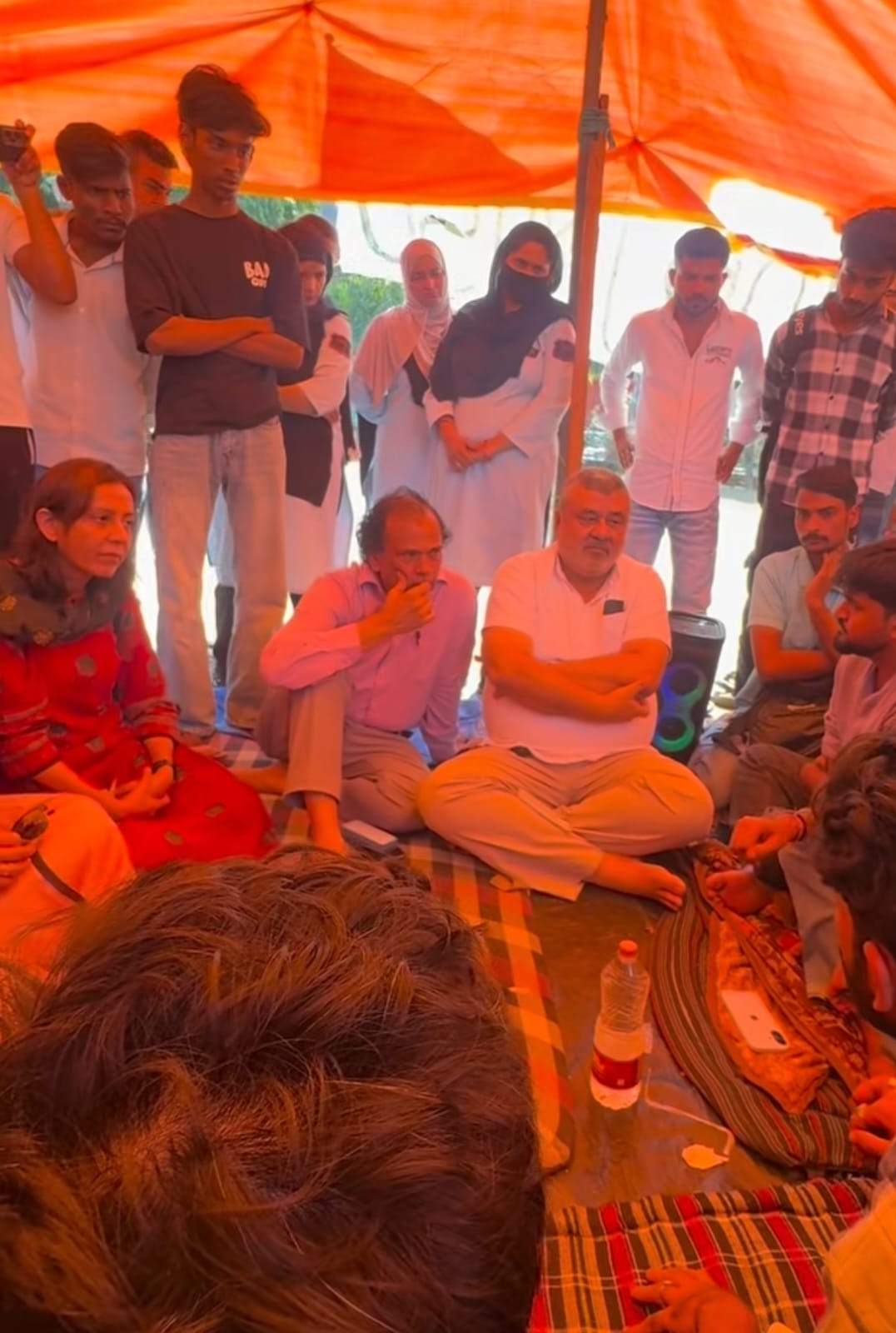
Jamia Millia Islamia (JMI) has reiterated its commitment to resolving the ongoing student protest through dialogue, mutual trust and meaningful and constructive engagement. Following the constitution of a high-level seven-member committee comprising senior Deans and Professors on October 18, 2026, to engage with the protesting students and examine their demands, the committee initiated a series of discussions and took further steps towards addressing the issue of students’ representation on campus.
The committee reached out to the protesting students the very next morning on October 19th and visited the protest site to initiate a dialogue. The initial interaction was productive and laid the groundwork for further engagement. Subsequently, the committee requested a list of bona fide students and invited a representative group of students for a discussion at the office of the Dean of Social Sciences. In response to the invitation, student representatives attended the 2-hour meeting on October 20 at the office of the Dean of the Faculty of Social Sciences in which their grievances were heard and discussed. A further meeting was held at 6:30 p.m. on October 20 at the Dean of Students’ Welfare (DSW) office to formalise the minutes of the discussion, incorporating the broad suggestions put forward by the students. However, despite several rounds of discussion and efforts to finalise the document, the students did not agree to sign the minutes.
Notwithstanding this, the above committee and the JMI administration has continued to work towards finding a resolution to the issue. Under the chairmanship of the Vice-Chancellor, Prof Mazhar Asif, and in the presence of the Registrar, JMI, Prof. Md. Mahtab Alam Rizvi, a meeting was convened today with all the members of the high-level committee constituted on October 18, along with all Deans of Faculties, JMI; the Dean of Students’ Welfare; the Controller of Examinations; the Dean of Academic Affairs; the Chief Proctor; all Provosts; the Chief Public Relations Officer; and the Security Advisor. The meeting deliberated on the recommendations of the high-level committee and their discussions with students and explored a way forward to restore peace and normalcy on campus.
Following detailed discussion, JMI has announced and notified the constitution of a committee to draft the Constitution of Jamia Millia Islamia Students’ Union (JMISU) in furtherance of Article 23(J)&(K) of JMI Act, 1988. The Committee will consider the circumstances leading to the dissolution of JMISU in 2006, various rulings of Competent Courts in relations to JMISU, and recommendations of the Lyngdoh Committee (2007).
The need for a comprehensive examination of the matter arises from the fact that the last Students’ Union at the University was dissolved in 2006. In the intervening two decades, several developments have taken place, making it necessary to review the issue in the light of the prevailing legal and institutional framework. The committee will examine the existing court orders concerning Students’ Union elections at JMI, the recommendations of the Lyngdoh Committee Report on student bodies and Students’ Union elections in universities, colleges and other institutions of higher education across India, as well as the applicable ordinances and statutes of Jamia Millia Islamia.
As part of its continued efforts to safeguard the well-being of the protesting students, the University administration has deputed a medical team under the supervision of the Chief Medical Officer, Dr Irshad Husain Naqvi, to continuously monitor the health parameters of students on hunger strike. An ambulance has also been stationed at the protest site to ensure immediate medical attention, should the need arise.
That said, JMI recognises freedom of expression as a fundamental right and an essential component of the democratic process. The university remains committed to providing students with appropriate avenues to express their views, concerns and dissent peacefully. In this spirit, the administration has created a designated space for students to exercise their right to free expression and has earmarked Gate No. 18 for student protests. However, the students have been protesting at the Ghalib lawns since October 12.
Besides, the administration has expressed deep concern over the defacement of the iconic and historic Ghalib statue, which has long stood as a symbol of the University’s identity and heritage. The damage to the university gates, particularly Gate No. 7, named after the country’s first Education Minister, Maulana Abul Kalam Azad as well as other gates, walls, departmental building facades and common areas, is equally regrettable. The destruction of property in and around the central lawn surrounding the Ghalib statue is a matter of serious concern and particularly grievous are the graffiti writings on the historic Ghalib statue.While firmly upholding the right to peaceful protest and dissent, the university appeals to all students to exercise these rights in a responsible and mature manner and to protect the infrastructure and heritage of the 106-year-old institution that belongs to the entire JMI community.
The administration is making every effort to address the issue of students’ representation, which has remained unresolved for nearly two decades. Recognising the importance and complexity of the matter, the University is committed to examining it comprehensively and arriving at a solution consistent with the Lyngdoh Committee recommendations, the Jamia Millia Islamia Act, 1988, the University’s applicable ordinances and statutes, and the relevant court orders concerning Students’ Union elections at JMI.
JMI remains committed to safeguarding students’ rights, upholding democratic values and restoring peace and normalcy on campus while protecting the University’s academic environment, heritage and national and international standing.
