
A Failed Vice-Chancellor Naima Khatoon presiding Over Chaos at Aligarh Muslim University – Prof Jasim Mohammad
The Failed VC Naima Khatoon Who Could Not Hold Aligarh Muslim University Together

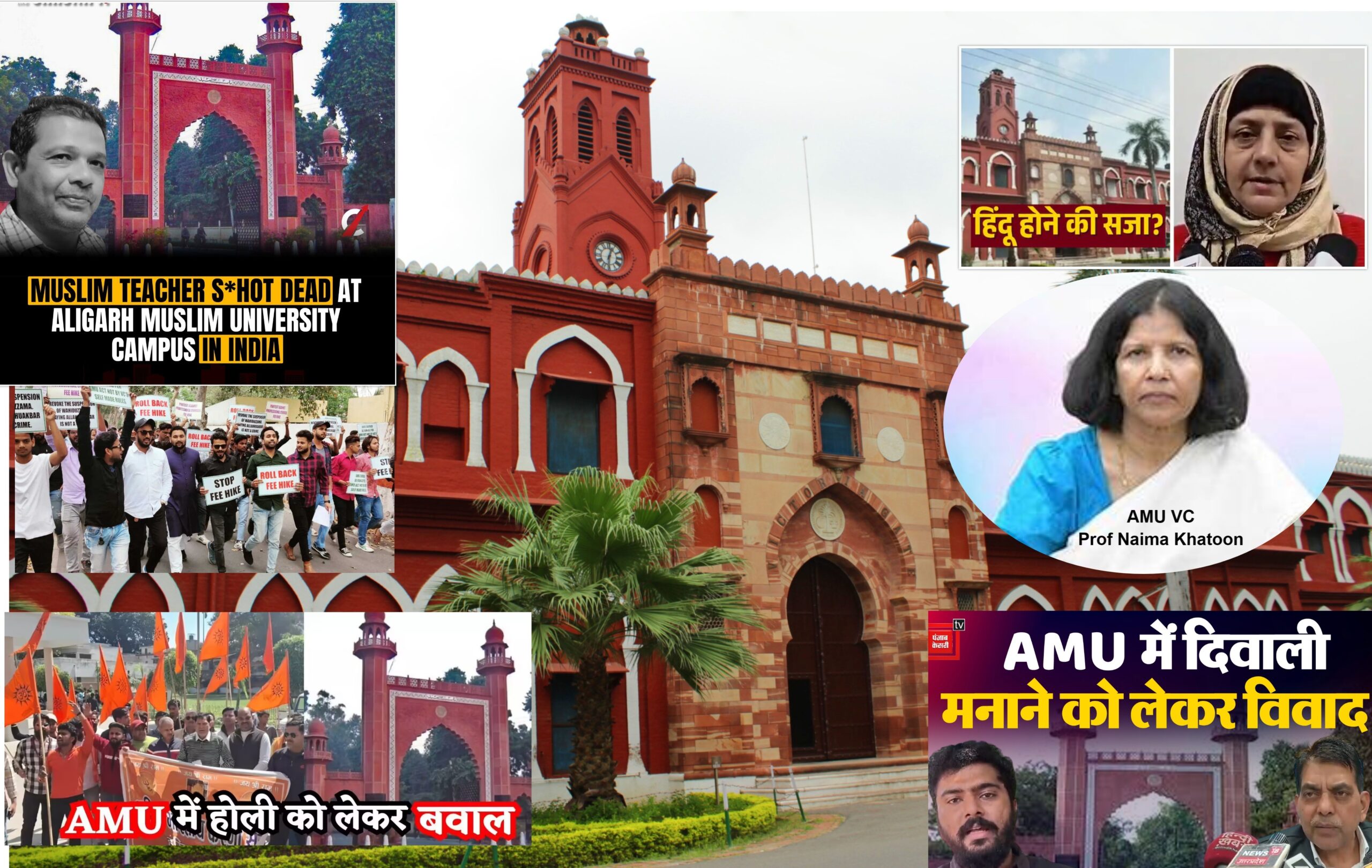
VC Naima Khatoon’s Failed Leadership Exposed
writes – Prof. Jasim Mohammad
When Naima Khatoon took charge as Vice Chancellor of Aligarh Muslim University in April 2024, there was an expectation—at the very least—that things would become more stable and academically focused. That hasn’t really happened. Over time, the campus has started to feel unsettled, with incidents taking place that one would not normally associate with a university of this stature. There is a noticeable unease now; you can sense it in conversations among students and teachers.
That discomfort came out openly on 1st May 2026, when the Aligarh Muslim University Teachers’ Association Hony Secretary Dr Mateen Ashraf issued a press release. The Association spoke about a series of incidents that, in its view, have disturbed the academic environment in a serious way.
One of the episodes it referred to was at the Department of Library and Information Science. What happened there, as described, was not just ordinary student indiscipline. There were reports of abusive behaviour towards staff, and language used against teachers that crossed basic limits of respect. More troubling were accounts that female students were pushed during the commotion, with some reportedly fainting and needing to be taken to the Trauma Centre. That kind of situation should not arise inside a university campus.
There are also serious concerns regarding how certain incidents have been presented. Contrary to earlier suggestions that a faculty member from the Department of Political Science was aligning with disruptive elements, accounts from within the campus indicate that Dr. Mohammad Aslam had, in fact, intervened to urge restraint and clearly appealed that students should not be treated as criminals. His intervention appears to have been guided by the concern that students should be dealt with through fair and due process rather than immediate punitive action.
What is deeply troubling, however, is the emerging pattern that follows. There is a growing perception across the campus that the moment students raise their voices—even on legitimate concerns—they are met with swift punitive action, often without adherence to due process. When procedure is bypassed and punishment becomes the first response, it creates an atmosphere of fear rather than order. If universities begin to function in a manner where students are pre-judged and treated with suspicion, the very idea of a university stands compromised. Campuses are meant to encourage questioning, not suppress it. The current approach, as it is increasingly being perceived, risks turning an academic institution into a space governed by intimidation rather than dialogue.
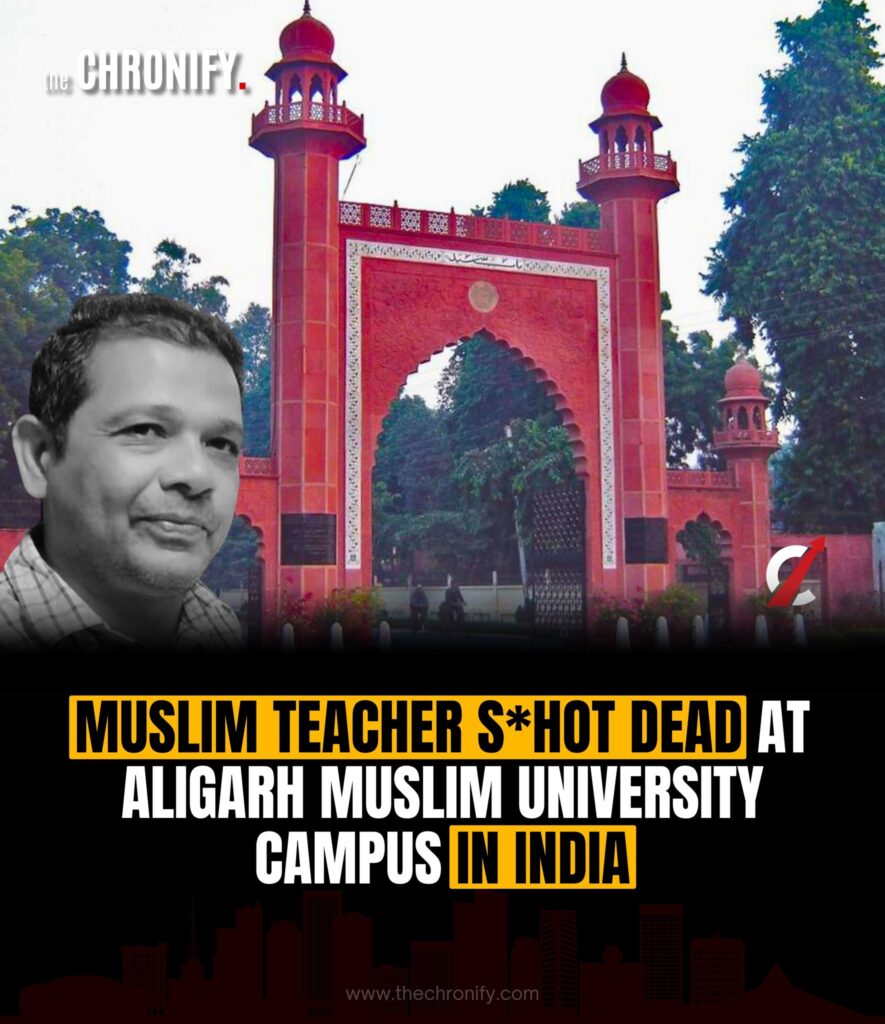
What is unfolding at Aligarh Muslim University since Naima Khatoon assumed charge is no longer an internal administrative lapse or an episodic conflict between individuals. It has reached the level of a systemic breakdown of governance. The Vice-Chancellor is the constitutional guardian of academic integrity, campus harmony, and institutional justice. Regrettably, at AMU, this responsibility has been reduced to passive spectatorship. Repeatedly and consistently, the Vice-Chancellor has failed to act—even when confronted with serious complaints involving communal prejudice, professional harassment, statutory violations, and the most horrifying outcome imaginable: the brutal murder of Rao Danish Ali, a teacher at AMU’s ABK High School, inside the AMU campus stands as another stark example. Developments in the public domain after the incident have further reinforced the perception that the tragedy was the result of prolonged administrative negligence and institutional failure.
In a press conference following the murder, the Senior Superintendent of Police (SSP), Aligarh, stated that a majority of CCTV cameras across the campus were non-functional. This revelation exposes the weakness of the university’s security claims. A campus of such stature allowed its surveillance system to deteriorate—even in sensitive areas like the Maulana Azad Library, where the murder took place.
The fact that these systems were neither repaired nor regularly audited indicates that campus security was not treated as a priority.
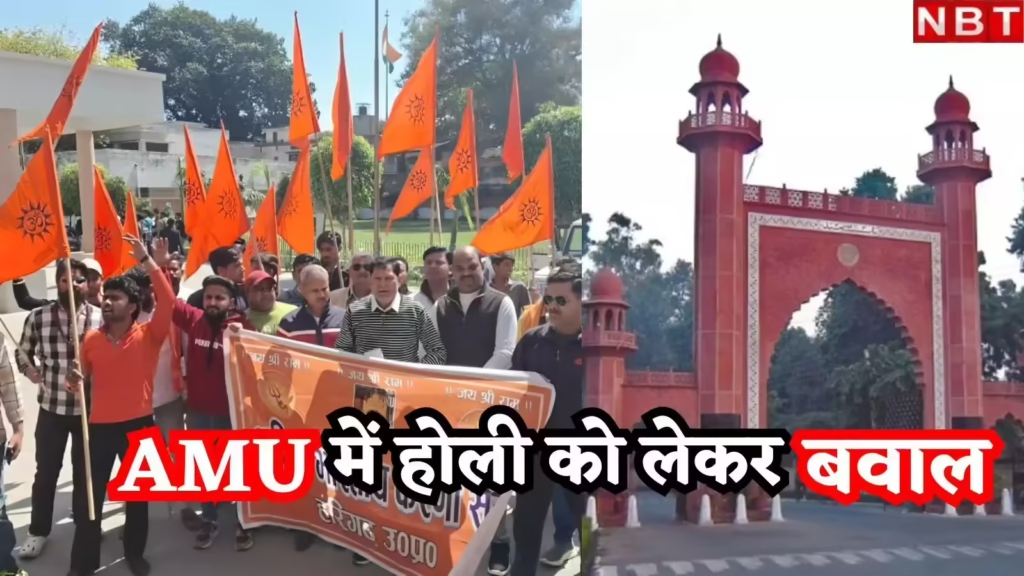
What makes this lapse even more serious is that it followed earlier warning signs. In March 2025, a violent incident took place within the campus. That moment should have triggered immediate corrective action—strengthened surveillance, increased vigilance, and clear accountability. Instead, the response was inadequate.
The Vice-Chancellor remains the highest executive authority of the university. Under the present tenure, the security framework at AMU appears to have weakened significantly. When a teacher is killed within campus boundaries and it is later revealed that surveillance systems were largely non-functional, accountability cannot be diffused. The murder of a teacher should have shaken the university administration to its moral core. It should have triggered urgent reforms, strict accountability, and visible leadership. Instead, what has emerged is an administration that appears numb, indifferent, and disturbingly detached from the gravity of its own failures. Fear has been normalised. Trauma has become embedded. Silence has been turned into a tool of control.

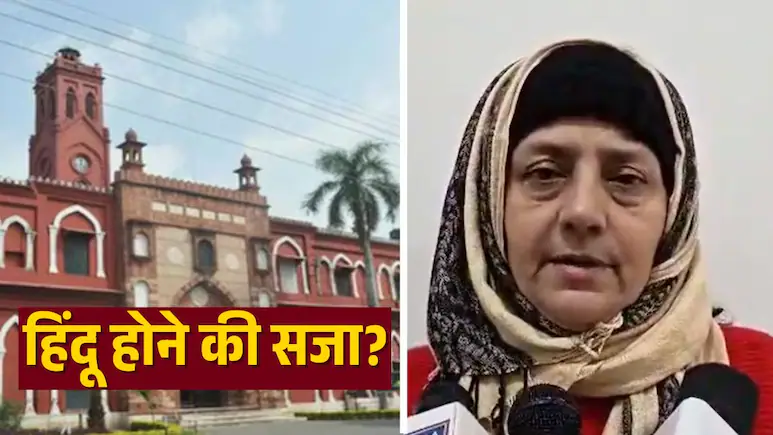
This failure becomes even more disturbing in light of the complaint submitted to the Vice-Chancellor on September 2025 by Hindu widow Senior professor Rachana Kaushal. The allegations—denial of statutory rights, deliberate exclusion from academic bodies, humiliation, professional marginalisation, and communal targeting—are of such seriousness that any responsible Vice-Chancellor would have intervened immediately, suspended questionable decisions, and ordered an impartial inquiry. None of this was done.
Instead, the inaction allowed prejudice to deepen and misconduct to gain confidence. What makes this failure even more indefensible is that the matter should have been resolved within the university itself. Universities are meant to address disputes through transparent, fair, and dignified processes. When a senior professor is compelled to approach external authorities because the Vice-Chancellor refuses to act, it becomes a clear indictment of administrative collapse.
Since June 2017, and with greater intensity in recent years, AMU has increasingly turned into an environment marked by fear, anxiety, and psychological stress for both teachers and students. In such a climate, the ideals of the National Education Policy 2020 cannot be realised. Innovation cannot flourish where there is fear. Critical thinking cannot grow where there is insecurity. An institution paralysed by mistrust cannot educate a generation.

The continued silence of the Vice-Chancellor in the face of allegations of communal bias is particularly dangerous. A central university cannot be allowed to drift into suspicion and factional divisions. Such failures do not remain confined within campus walls—they send damaging signals into society and threaten academic harmony beyond the institution.
What happens at Aligarh Muslim University matters to the nation. It is difficult but necessary to state that the present leadership has failed in its constitutional, administrative, and moral responsibilities. Leadership is measured by courage, fairness, and timely action—and on these counts, the administration has fallen short.
The Department of Higher Education, Ministry of Education must intervene without delay. This situation demands more than routine correspondence or internal committees. It calls for a high-level, independent inquiry into the functioning of the Vice-Chancellor, the Internal Discipline Committee, and the overall governance of the university. Accountability must be established, responsibility fixed, and corrective measures implemented decisively.
If this moment is allowed to pass without firm action, the damage—to AMU, to public trust in universities, and to the larger academic ecosystem—will be long-lasting. Silence at this stage will be interpreted as consent.
At this point, it’s hard to avoid saying it plainly: the tenure of Naima Khatoon at Aligarh Muslim University has not worked the way it should have. A Vice-Chancellor is expected to step in, take charge, and steady the institution when things begin to slip, but that sense of leadership just hasn’t been felt. Instead, what people see is delay, silence, and issues dragging on without resolution. Put simply, the university hasn’t been held together the way it needed to be, and what worries many is not just what has already gone wrong, but the feeling that nothing decisive is being done to fix it.

(Author is Donor, Alumnus of AMU and Former Media Advisor of Aligarh Muslim University. Email: profjasimmd@gmail.com)
