
Swami Vivekananda’s Spiritual Vision Holds the Key to India’s Civilisational Identity : NSA Ajit Doval
Youtube Link : https://www.youtube.com/live/_gWVoWFJNcA
Vivekananda’s Vision of Spirituality, National Pride and Collective Strength Remains Vital for Nation-Building: Book Released at VIF

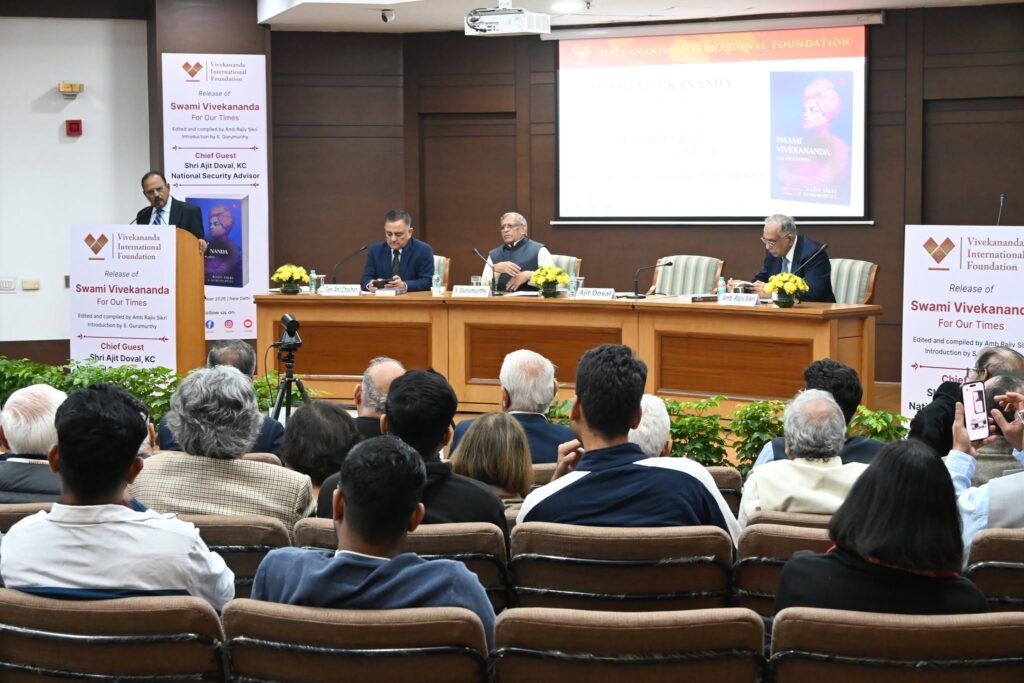
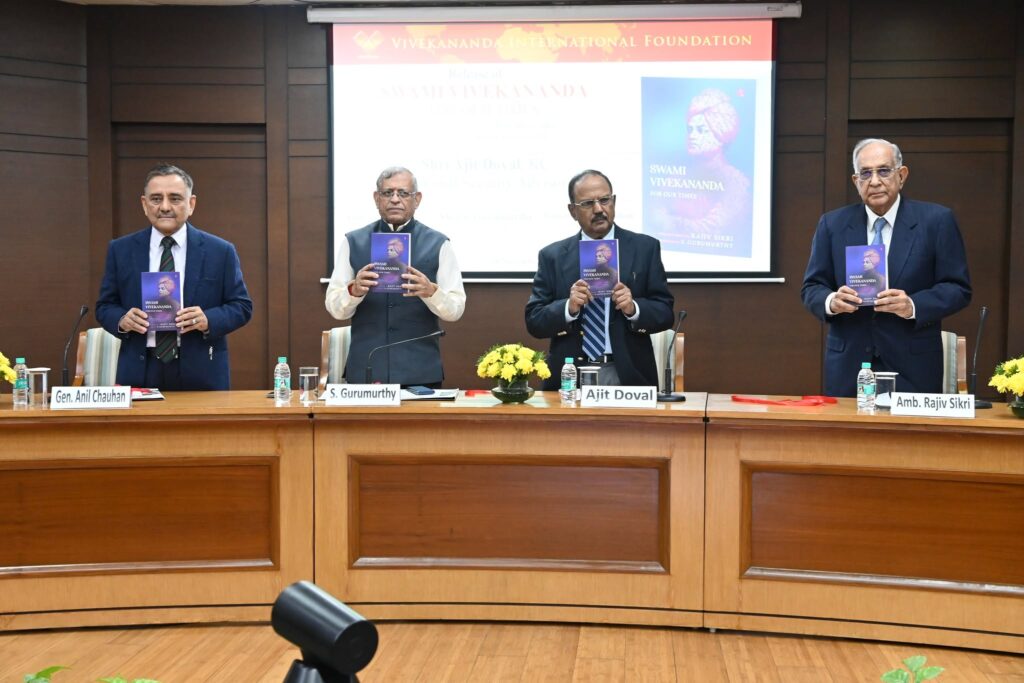
New Delhi: The Vivekananda International Foundation (VIF) hosted the book release of ‘Swami Vivekananda for Our Times’, released by Shri Ajit Doval, KC, National Security Advisor. Edited and compiled by Amb. Rajiv Sikri, former Secretary, Ministry of External Affairs, the book carries an introduction by Shri S. Gurumurthy, Chairman, VIF.
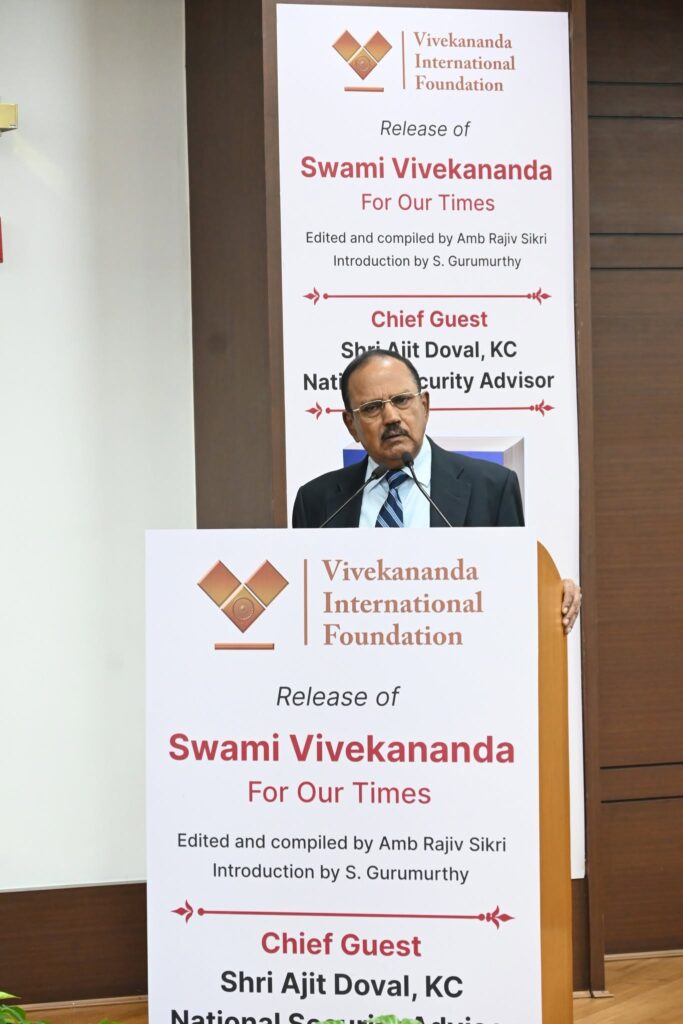
Delivering the keynote address, Shri Ajit Doval, KC, National Security Advisor, emphasised that spirituality and civilisational values form the bedrock of India’s unique national identity. Explaining how India’s nationhood differs from conventional Western conceptions of statehood, he observed that, “Every nation has got some unique character on which its statehood depends, and for India it is, its spirituality.”
NSA highlighted how Swami Vivekananda recognised the deep-seated hopelessness and loss of pride among Indians, traumatised by centuries of foreign rule and subjugation, and he sought to awaken society from its slumber, using spiritual values as a dynamic force for national regeneration.
Focusing on the path forward, he emphasised Swami Vivekananda’s call for internal transformation within every citizen, followed by individual empowerment, collective organisation and the convergence of strengths. Underscoring the importance of coordinated action, he observed, that the secret lies in organisation in coordination of action that is individual actions and individual strengths have got to be converged together to bring about the coordinated action.
Concluding, Shri Ajit Doval noted that Vivekananda’s spiritual awakening laid the intellectual and moral foundations for India’s freedom movement, inspiring both leaders and revolutionaries. By breathing life back into a degraded society, Swami Vivekananda sparked a nationwide consciousness that continues to guide India’s modern resurgence, till date.
यह भी पढ़ें
In his address, Amb. Rajiv Sikri, author of the book, spoke about how his engagement with Swami Vivekananda’s original writings, which began during his diplomatic assignment in Kazakhstan, developed into two decades of study. He acknowledged Chairman VIF, Shri Gurumurthy’s encouragement and support in bringing the book together.
Describing Swami Vivekananda as a spiritual leader, humanist, thinker and, above all, a nationalist, he highlighted his patriotism alongside his concern for humanity. The book explores three themes: the essence of religion and interfaith harmony; India’s spiritual and religious traditions; and the achievements and strengths that can help India realise its potential.
He also called for Swami Vivekananda’s works to be translated into other Indian languages to reach wider audiences.
In his introductory remarks, Shri S. Gurumurthy, Chairman, VIF, highlighted the significance of Swami Vivekananda’s thought in understanding India’s civilisational foundations. He observed that the colonial experience and post-Independence institutional frameworks had not adequately engaged with the core ideas of Swami Vivekananda, a gap that Amb. Sikri’s work seeks to address.
Emphasising that “Vivekananda” represents not merely a name but a character and a civilisational thought, he highlighted Swami Vivekananda’s advocacy of interfaith dialogue and his understanding of religion as an essential dimension of human civilisation. He described the book as an important contribution to the wider effort to rediscover and understand India’s civilisational heritage.
In his opening remarks, General Anil Chauhan, Director, VIF, recalled Swami Vivekananda’s historic address in Chicago, which transformed the world’s perception of India and its spiritual heritage.
Highlighting the relevance of his ideas in an era of AI, fake news and misinformation, he emphasised Swamiji’s insistence on reason, his articulation of India’s civilisational identity and the enduring relevance of his thought amid contemporary geopolitical turmoil.
