
CDOE, Jamia Millia Islamia Hosts Special Lecture on ‘Global Peace in 2026: Challenges and Prospects’

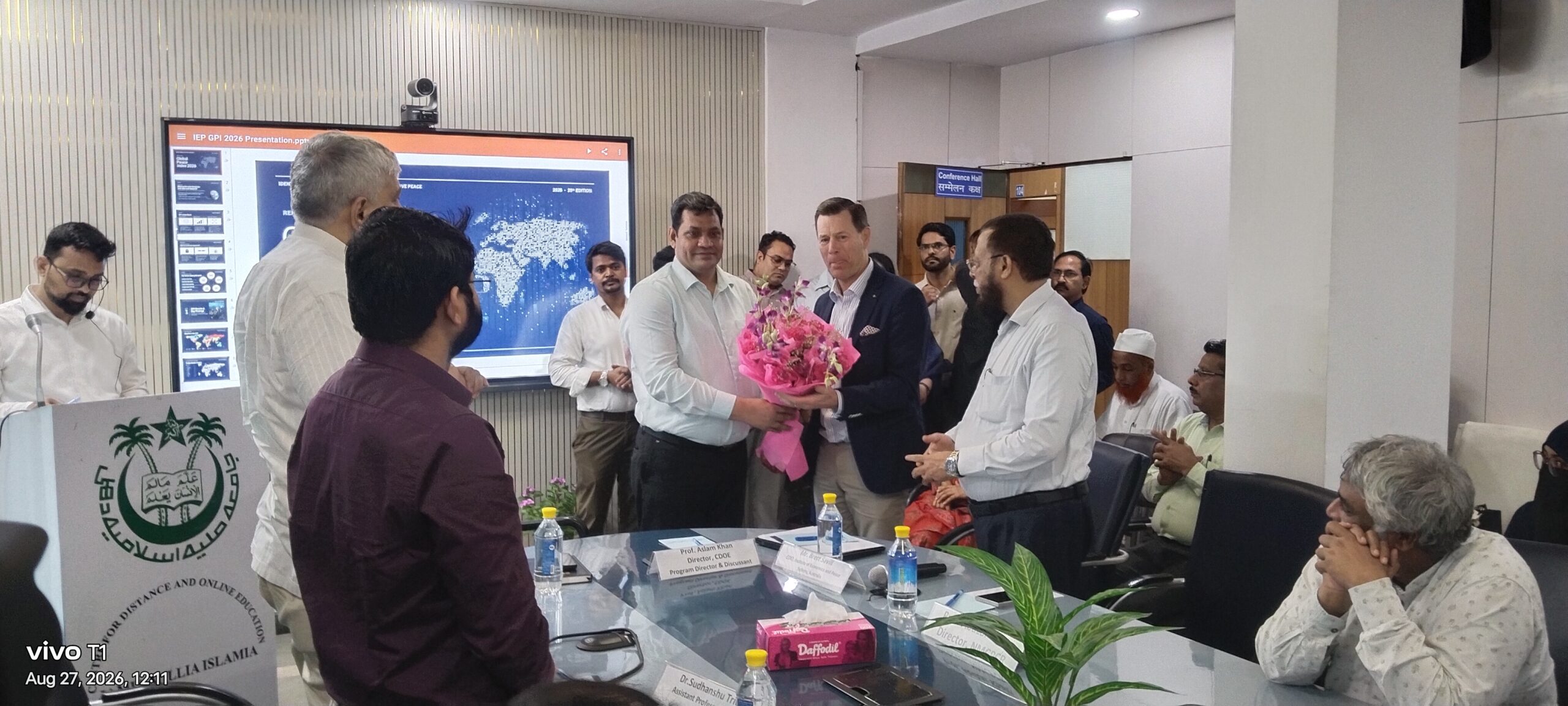
The Centre for Distance and Online Education (CDOE), Jamia Millia Islamia (JMI), in collaboration with the Nelson Mandela Centre for Peace and Conflict Resolution (NMCPCR), organised a Special Lecture on “Global Peace in 2026: Challenges and Prospects” at the CDOE Conference Hall. The programme was organised under the patronage of Prof. Mazhar Asif, Hon’ble Vice-Chancellor, JMI, and with the support and guidance of Prof. Md Mahtab Alam Rizvi, Registrar, JMI.
The distinguished speaker, Mr. Brett Savill, Chief Operating Officer, Institute for Economics & Peace (IEP), Sydney, Australia, delivered the lecture. The programme was organised under the leadership of Prof. Aslam Khan, Director, CDOE and Professor, NMCPCR, while Prof. Abuzar Khairi, Director, NMCPCR, welcomed the distinguished speaker and the gathering.
Mr. Savill discussed the changing global peace landscape with reference to the Global Peace Index (GPI), which assesses peace through 23 indicators covering societal safety and security, ongoing conflict and militarisation. He noted that global peacefulness has declined in 15 of the past 18 years and highlighted the changing nature of conflicts, including the growing role of external powers, proxy actors and prolonged conflicts.
While discussing India, Mr. Savill observed that comparisons with smaller and relatively homogeneous countries may not adequately reflect India’s size, diversity and geographical complexities. He suggested that comparisons with larger countries such as China, the United States and Brazil could provide a more meaningful perspective.He also spoke about the increasing use of Artificial Intelligence and drone warfare, particularly in the Russia-Ukraine conflict, and drew attention to the growing gap between investment in AI for warfare and AI for peace.
Prof. Rajiv Nayan, NMCPCR, while responding to the lecture, highlighted the need to critically examine the methodology and indicators used to measure peace. Drawing upon Indian intellectual traditions, he emphasised that peace must be accompanied by justice to remain meaningful and sustainable.
In his concluding remarks, Prof. Aslam Khan emphasised that peace cannot be understood merely as the absence of war or through a single indicator. He called for a broader, systems-based approach that recognises the interconnected roles of security, development, governance, technology, justice, culture and human well-being. He also underlined the need to critically engage with global indices while developing perspectives rooted in local contexts and intellectual traditions.
The lecture was followed by an interactive question-and-answer session with faculty members, research scholars and students. The programme concluded with a vote of thanks by Dr. Sudhanshu Trivedi, Assistant Professor, NMCPCR.
