
Constitutional Values and Fundamental Duties: Inspiring Generation Z to Uphold the Spirit of the Constitution – Prof. Jasim Mohammad

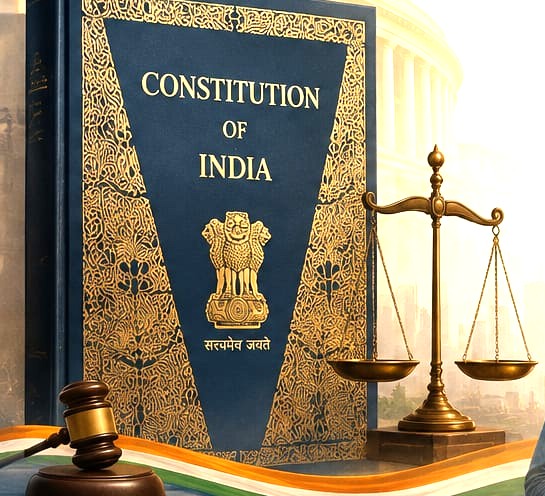
India is reaching the milestone of 80 years of Independence. Eight decades ago, India became independent after a fierce struggle, during which countless patriots laid down their lives to bring about a free and just society that respects the rights of all. India’s freedom allowed our nation to enter a new phase of development guided by the principles enshrined in the Indian Constitution. As India marches towards becoming Viksit Bharat @2047, the Indian Constitution continues to be a guideline for our nation’s journey. Thus, the 80 th anniversary of India’s independence is a good opportunity to remember these values and share them with the younger generations.
The Constitution of India was adopted on November 26, 1949, and came into force on January 26, 1950. It provided the new democratic republic with a guideline for organizing the state and regulating citizens’ relations. Adopting the Constitution marked the beginning of India’s development as a modern democratic state. The Constitution provides justice, liberty, equality, and fraternity to all citizens.
The Preamble to the Constitution highlights India’s core constitutional values, which are simple but profound. They remind Indians that justice ensures equality and protects the rights of the weak, while liberty and equality create the foundations for fraternity, which, in turn, is essential for building a strong and harmonious society. Moreover, India’s Constitution has proven to be durable. It has endured through India’s political and social changes as well as economic growth, technological advancement, and digital transformation. This resilience is explained by the fact that the Constitution serves as a guiding principle of state governance that allows political power to be exercised with a focus on the people’s welfare.
At the same time, the Constitution balances the rights guaranteed to citizens and the duties that need to be fulfilled for the country to develop successfully. The Constitution grants numerous fundamental rights to citizens. However, it also reminds them of their fundamental duties, including respecting the Constitution, the National Flag, and the National Anthem; cherishing the ideals and spirit of freedom struggle; maintaining unity and integrity of the nation; promoting harmony; preserving cultural heritage; protecting the environment; developing scientific temper; conserving public property; and striving for excellence.
Today, the need to remind Indians of their Fundamental Duties resonates even stronger, as being a part of a thriving democracy requires responsibility and a spirit of public service. Indeed, rights and duties go hand in hand, as they both contribute to individuals and, consequently, the country as a whole, becoming better. Freedom of speech, for example, does not only entail the right to say what one pleases but also a duty to respect the opinions of others. Similarly, while the Constitution guarantees religious freedom, this right implies respect for the religious feelings of others. The same applies to the right to equality and the duty to treat everybody equitably, without discrimination. In fact, a person’s duties are often derived directly from their rights. For instance, a citizen’s right to a healthy environment imposes a duty to take care of nature. In addition, upholding constitutional values is a fundamental duty of every citizen, as well as a fundamental freedom because a morally strong and prosperous society is necessary for individuals to flourish. Therefore, for a successful democracy, it is essential to cultivate a responsible and accountable citizenry that is willing to participate in and contribute to society, and the state.
The current generation of young people may be the luckiest one, as they are living in an era of rapid digital transformation and globalization. Indians have access to smartphones and the Internet, are increasingly using digital technologies for entertainment and communication, and are actively engaging in commerce online. The current young people have an opportunity to be a part of India’s economic and social transformation, as they are already actively participating in India’s innovation-driven economy and digital ecosystem. At the same time, the ability to go digital does not make them digitally literate, let alone morally developed. Thus, there is a need to ensure that young Indians are constitutionally literate and understand their rights, duties, and freedoms as provided by the Constitution and the laws of the land. Especially in the era of AI and the digital transformation of society, the Constitution can help India’s young people navigate their way through the rapidly evolving digital landscape without losing sight of core constitutional values.
In this regard, it is especially important for educational institutions to develop and promote constitutional values. Constitutional education should be comprehensive and go beyond simply discussing constitutional texts and articles during classes. It should also be reflected in the daily activities of educational institutions, enabling students to internalize constitutional values and attitudes. For instance, students can be encouraged to take part in debates and youth parliaments, to express their views and votes on matters of public interest, to volunteer in their communities, and to take care of the environment through tree plantation drives and other activities. Thus, by engaging in youth parliaments, social media, and other public forums while studying at school or college, students can learn and understand what it means to be a responsible citizen. At the same time, educational institutions should nurture their students’ ability to reason, think critically, and form opinions, as well as teach them constitutional ethics, equality, gender sensitivity, environmental consciousness, and social responsibility. Consequently, in their studies and future profession, these students will be accountable and responsible citizens who are not only successful but also socially aware.
India’s youth can and should play a major role in taking our country to Viksit Bharat @2047. Young people today are already making significant contributions to India’s development as they are active participants in India’s innovation and entrepreneurship-driven economy. Moreover, India’s youth will become an integral part of the country’s democratic system and governance in the years to come.
However, not only economic growth and digital transformation but also social development are essential for Viksit Bharat @2047. This vision of India as a developed country entails a move from a rights-based to a duties-based approach. It implies that India’s citizens will contribute more to society and the country than they take from it. This goal can be achieved only if India’s citizens, starting with its youth, become more accountable and responsible. Thus, as a visionary social contract, the Constitution calls on every citizen of India to promote the general welfare. India’s young people have a constitutional responsibility to make India not only technologically progressive but also strong in terms of social capital and moral capital. They should strive to become strong in character, values, and intellect while serving the country and society. The Constitution, which guides and inspires Indians, will be a helpful tool in achieving this goal.
Today, as India progresses towards Viksit Bharat @2047, it is important to remember that the Constitution’s fundamental values, including justice, liberty, equality, and fraternity, will remain relevant for years to come. The phrase Panch Pran (Five Breaths) in the Preamble to the Indian Constitution signifies the resolve of India’s leaders to build a developed country while removing any trace of colonial mentality and nurturing unity, self-confidence, pride, and the spirit of service. Constitution Day promotes constitutional literacy and awareness among Indians of all ages. It also inspires them to respect the Constitution and its values as the guiding star of the country. In fact, this day is not only a milestone in the life of the nation but also an opportunity for young people to demonstrate their patriotism by becoming responsible and dutiful citizens.
India’s youth can dedicate this year’s Constitution Day to remembering that India’s freedom is their freedom, which they should cherish and use for the benefit of all. They can also dedicate this day to promoting constitutional values by engaging in discussions and debates, social media, and other activities to raise public awareness of the Constitution and its meaning for India’s youth. Moreover, they can dedicate this day to fulfilling their duties as citizens of India. Even though these duties may seem small, they can contribute to building a better India through service to the country and society. Every Indian can become a true patriot and take pride in carrying out simple duties, such as respecting the Constitution, the National Flag, and the National Anthem, adhering to the rule of law, and protecting the environment. By doing so, India’s youth can show that they truly love their country, respect their Constitution, and care about their fellow citizens. The Constitution Day can be a day of action for India’s youth, enabling them to contribute to making our country great.
India’s youth have the ability to shape the future of this country and become true constitutional citizens. This is the best way for them to commemorate India’s Independence Day as well as Constitution Day. As India’s young people dedicate themselves to fulfilling their duties to the country and society, they will play their part in taking India to Viksit Bharat @2047. India’s Constitution has come a long way since January 26, 1950. It has guided India’s political, economic, and social development, nurturing a strong and prosperous democratic state. And today, it continues to inspire Indians to build an India that is developed, strong, and prosperous. Indians of all ages are reminded that not only the government but also every citizen plays a vital role in India’s development. It is the duty of every citizen to participate in and contribute to the making of this great country. In fact, India’s youth should remember that their future is inseparable from the future of their country. Thus, while enjoying the fruits of freedom, Indians of all ages should dedicate themselves to serving the country and making it the best possible.

(Author is Chairman, Centre for NaMo Studies (CNMS) Email: namostudies@gmail.com )
