
“Peace has to be a priority; we will never get security without peace”: H.E. Mr. Miguel Ángel Moratinos, High Representative of United Nations Alliance of Civilizations at Jamia Millia Islamia during his official visit to India

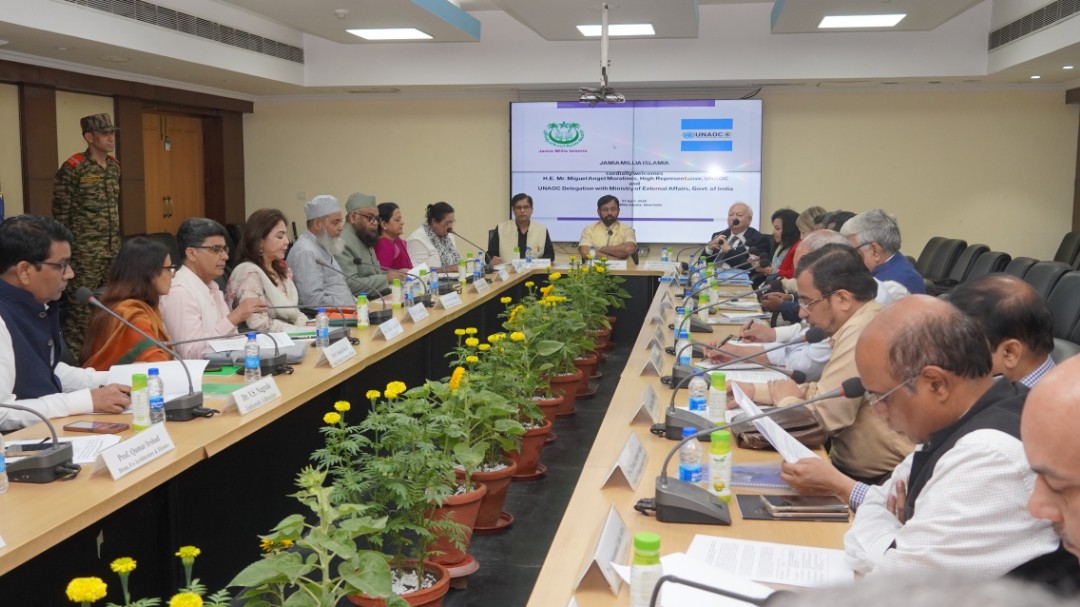
NAI DILLI : Jamia Millia Islamia hosted His Excellency Mr. Miguel Ángel Moratinos, Under-Secretary-General, High Representative for the United Nations Alliance of Civilizations (UNAOC), and United Nations Special Envoy to Combat Islamophobia, yesterday, during his official visit to India. The visit marked an important engagement aimed at promoting dialogue, mutual understanding, and cooperation among diverse cultures and societies.
The visiting delegation comprised H.E. Mr. Miguel Ángel Moratinos; Ms. Nihal Saad, Director, UNAOC; Ms. Anna Pavlyuchenko, Programme Officer, Institution and Member States Relations Advisor; Mr. Muhammed Shabeer K, Under Secretary (UNES), Ministry of External Affairs; Mr. Suresh Chandra Bhatt, PA to Joint Secretary (UNES-II), Ministry of External Affairs; and Ms. Devanshi Saxena, Officer Trainee, Ministry of External Affairs, Government of India.
From Jamia Millia Islamia, the meeting was attended by the Vice-Chancellor, Registrar, Dean (Academic Affairs), Dean (International Relations), Dean (Research and Innovations), Controller of Examinations, Chief Proctor, University Librarian, Chief Public Relations Officer (CPRO), Deans of all Faculties, along with other senior officials of the University.
The programme commenced with a formal welcome by Prof. Md. Mahtab Alam Rizvi, Registrar, Jamia Millia Islamia, who warmly received the distinguished delegation and highlighted the University’s legacy as a premier institution committed to inclusive education, cultural diversity, and academic excellence. He emphasized the university’s continued engagement in fostering international collaborations and intercultural dialogue, in line with the values promoted by the United Nations Alliance of Civilizations. Prof Rizvi giving a detailed account of the origins of the current conflict in West Asia and the Arab-Israeli dispute and drawing upon the region’s complex history of accords, and the implications of major powers in the conflict, underscored the need for peace-building and conflict resolution as the way forward. He said that JMI’s Nelson Mandela Centre for Peace and Conflict Resolution where he is also a Professor, has for the last two decades been fully committed to teaching and research that is aimed at peace-building.
H.E. Mr. Miguel Ángel Moratinos, Under-Secretary-General of the United Nations and High Representative for the United Nations Alliance of Civilizations (UNAOC), in his address underscored the importance of intercultural dialogue, inclusive societies, and partnerships with academic institutions in fostering peace and mutual understanding. Emphasizing the role of universities in shaping responsible global citizens, he encouraged greater youth engagement in building bridges across cultures. He highlighted three key global concerns requiring collective action, namely, peace, Sustainable Development Goals (SDGs), especially climate change and the need to protect the planet; and the emerging challenges posed by Artificial Intelligence while stressing the importance of ethical frameworks, multilateral cooperation, and responsible technological development.
Referring to the current war raging in West Asia and the plight of humanity every time there is conflict and war, H.E. Mr. Miguel Ángel Moratinos emphatically stated. “Peace has to be a priority. We will never get security without peace. In the last four decades, governments and state actors have placed security first and have failed. Every time we put security we fail. More security will provide more insecurity. We will attain security only through peace.”
Denouncing wars, which can’t save humanity H.E. Mr. Moratinos warned that it was unfortunate that we spend trillions on wars instead of focusing on addressing key problems before humanity, those of poverty, hunger, education and sustainable health. Mr. Moratinos, sending out a strong message of peace to the world said, “There may be many cultures, many countries and civilizations, but we all form one humanity.”
In his Presidential Remarks, Prof. Mazhar Asif, Hon’ble Vice-Chancellor, Jamia Millia Islamia, reiterated JMI’s rich history of commitment to pluralism, coexistence, and nation-building. He emphasized the relevance of love and compassion in today’s world, drawing from the inclusive traditions of Sufism, and reflected on various “isms,” calling for a shift towards shared human values with love, peace and harmony as the driving force behind all human enterprise. He highlighted universities as spaces for dialogue, critical thinking, and engagement among diverse communities, and expressed Jamia Millia Islamia’s deep interest in strengthening cooperation with UNAOC in areas of intercultural understanding, youth engagement, peacebuilding, and the promotion of shared human values.
The programme concluded with a vote of thanks delivered by Prof. Ushvinder Kaur Popli, Dean, International Relations, Jamia Millia Islamia, who expressed gratitude to the distinguished dignitaries, university leadership, faculty members, and students for their presence and contributions in making the event meaningful and successful. She stated that the visit provided an opportunity to strengthen institutional engagement and reaffirmed Jamia Millia Islamia’s commitment to promoting dialogue, cooperation, and global understanding in line with the objectives of the United Nations Alliance of Civilizations.
