JMI’s Academy of Professional Development of Urdu Medium Teachers organizes special lecutre on E-waste Management: Challenges and Sustainable Solution

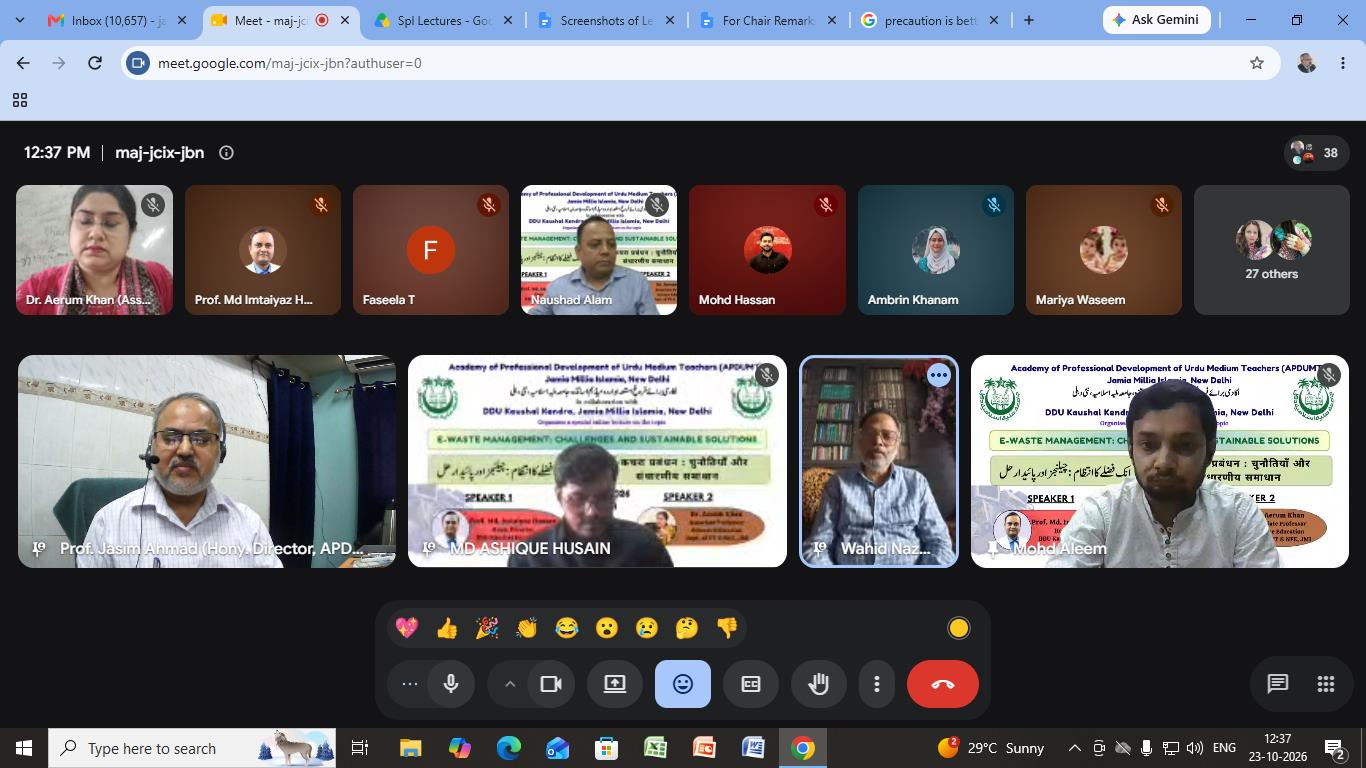
The Academy of Professional Development of Urdu Medium Teachers (APDUMT), Jamia Millia Islamia, in collaboration with DDU Kaushal Kendra, organised an online special lecture titled “E-Waste Management: Challenges and Sustainable Solutions” on 23 October 2026 at 10:45 a.m. The programme began with the recitation from Holy Quran by Mr. Shadab Alam, a B.Ed. student. Dr. Naushad Alam, Translator, APDUMT, JMI then welcomed all the delegates, including the invited speakers and audience and highlighted the importance of raising awareness about e-waste management.
The academy expresses sincere gratitude to Prof. Mazhar Asif, the Hon’ble Vice-Chancellor, JMI; Prof. Md. Mahtab Alam Rizvi, the esteemed Registrar, JMI; and Prof. Anita Rastogi, the Dean, Faculty of Education, for their support and guidance.
The first speaker, Prof. Md. Imtiyaz Hassan, Professor at the Centre for Interdisciplinary Research in Basic Sciences (CIRBS) and Director of DDU Kaushal Kendra, Jamia Millia Islamia, discussed the growing global e-waste crisis. He started his lecture stating that technology, while a blessing, can become a curse if the waste it generates is not managed properly. He highlighted that approximately 62 million metric tonnes of e-waste were generated worldwide in 2022, while only 22.3% was formally collected and recycled. He stressed the need for scientific recycling, responsible disposal and sustainable practices to address this growing challenge.
The second speaker, Dr. Aerum Khan, Associate Professor, IASE, focused on the environmental and social impacts of e-waste. She discussed soil, water and air pollution caused by improper disposal, along with the health risks faced by workers in the informal recycling sector. Referring to dependency theory, she explained how developed countries often shift e-waste processing to less-developed countries, leaving them to bear the environmental and health risks while the economic benefits remain unevenly distributed. She also highlighted the need for stronger regulations, producer responsibility and safer recycling practices.
In his Chair’s remarks, Prof. Jasim Ahmad, Director, APDUMT, highlighted India’s position as a destination for e-waste dumping and its significant domestic e-waste generation. He noted the role of third-party companies in e-waste management. He emphasised that e-waste management is a shared responsibility, not merely the government’s duty. He encouraged individuals to reduce unnecessary consumption, avoid replacing electronic devices just for status, repair items whenever possible, think carefully before discarding them, keep e-waste separate and dispose of it regularly through appropriate channels. He concluded by stressing that prevention is better than cure and that responsible choices at the individual level can make a meaningful difference.
The programme concluded with a vote of thanks delivered by Dr. Wahid Nazeer, Assistant Professor. He expressed his sincere gratitude to the Hon’ble Vice-Chancellor, JMI; esteemed registrar, JMI, Prof. Md. Mahtab Alam Rizvi; and Prof. Anita Rastogi, Dean, Faculty of Education, for their kind patron-ship and guidance. He also thanked both speakers, Prof. Md. Imtiyaz Hassan and Dr.Aerum Khan, Organising Secretaries Dr.Hina Afreen and Dr. Naushad Alam, and Coordinator Md. Ashique Hussain for their valuable contributions to the programme. He further acknowledged the participation of research scholars, Urdu teachers, teacher educators, and students. The lecture concluded by emphasising the need for collective responsibility and sustainable practices to address the growing challenge of e-waste.
The programme was anchored by Mr. Mohd. Ashique Husain, a Senior Research Fellow at the Dept. of Teacher Training and Non-Formal Education, JMI
